
Showing posts with label Leonard Janklowicz. Show all posts
Showing posts with label Leonard Janklowicz. Show all posts
Wednesday, January 28, 2015


Thursday, January 22, 2015


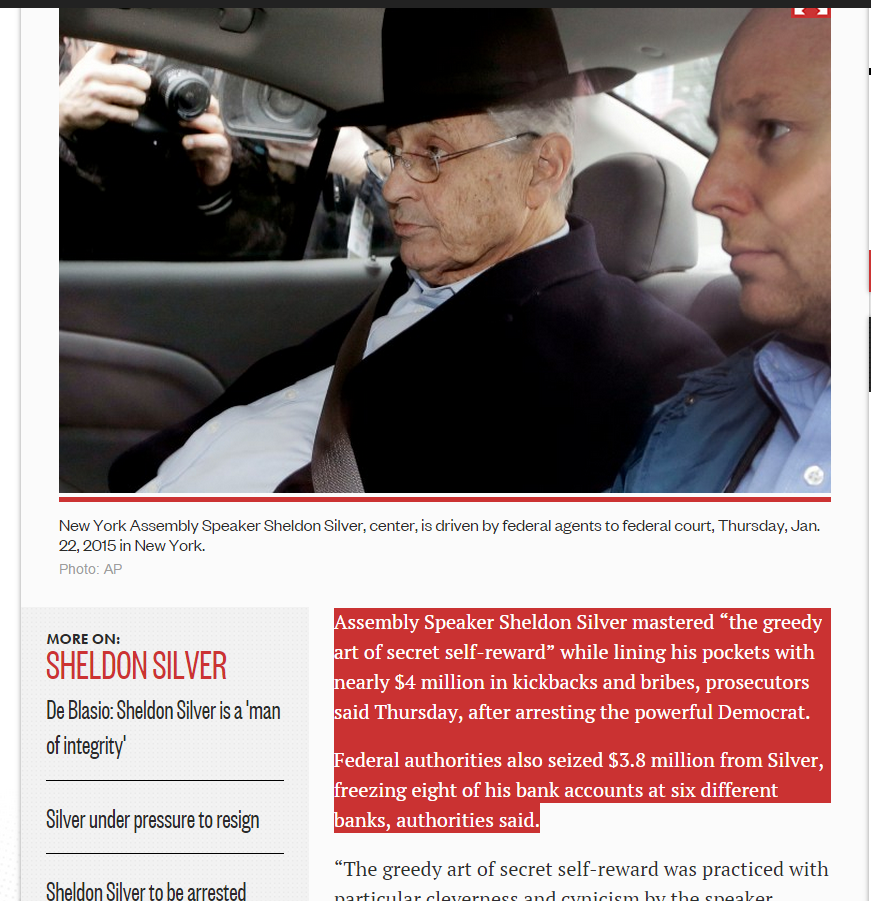
N.Y. Assembly Speaker Sheldon Silver accused of $4 million bribery and kickback scheme

N.Y. Assembly Speaker Sheldon Silver accused of $4 million bribery and kickback scheme, Dems continue to support him

Thursday, January 15, 2015


prisoner No. 46835-112
 prisoner No. 46835-112 http://www.thejewishweek.com/spinka This week, an undisclosed federal prison will become the new address of prisoner No. 46835-112, Naftali Tzvi Weisz, known to his thousands of followers as the Grand Rabbi of Spinka of Borough Park. Last December, Weisz, 61, was sentenced to two years in prison after pleading guilty to heading up a decade-long, $10 million money-laundering scheme in which donors to Spinka charitable institutions secretly received kickbacks of up to 95 percent of their donations. The rabbi’s gabbai, or assistant, Moshe Zigelman, also received a two-year sentence.
Last December, Weisz, 61, was sentenced to two years in prison after pleading guilty to heading up a decade-long, $10 million money-laundering scheme in which donors to Spinka charitable institutions secretly received kickbacks of up to 95 percent of their donations. The rabbi’s gabbai, or assistant, Moshe Zigelman, also received a two-year sentence. Five others involved in the scheme received lesser sentences.
Rabbi Weisz is not the only Orthodox rabbi to recently find himself on the wrong side of the law. Last summer, three rabbis of the Syrian Orthodox community, including its chief rabbi, Saul Kassin, were arrested in New Jersey and New York on charges of money laundering. But the Spinka Rebbe of Borough Park is perhaps the first leader of a chasidic dynasty to become a jailbird. It has gone unnoticed, however, that his name carries a historic distinction invoking a singular artifact of the Holocaust known as the Auschwitz Album.
Found by chance in an abandoned German barrack by a young Auschwitz survivor in April 1945, as the Third Reich was in its death throes, the 56-page album contains the only known photos of Jews at Auschwitz-Birkenau other than two photos taken secretly within a crematorium enclosure and smuggled out of the camp. Photography, except for “mug shots” of incoming non-Jewish prisoners, was normally forbidden even to the S.S., at the largest Nazi killing center. This tattered brown album, bound by a tasseled cord, was most likely ordered up as a private souvenir by a high SS camp official. In a deception that even the victims hoped to be true, it carries the hand-lettered title, “Umsiedlung der Juden aus Ungarn” (“Resettlement of Jews from Hungary”).
The album’s nearly 200 clear snapshots, organized as a pictorial narrative, first show the newly arrived victims in all their exhaustion, confusion and stoic dignity as they tumble out of the boxcars. It follows them as they line up before jack-booted SS inspectors for the infamous selection while their belongings are pillaged. Family members can be seen anxiously looking for one another as a minority is split off to be slave laborers while all others are led to the gas. No actual violence is seen, although in one photo, a group of older women and children are shown gazing calmly at the camera against a backdrop of what appears to be a red-brick administrative building. It is actually one of the four Birkenau crematoria, then working overtime. Beneath it are the undressing rooms and capacious gas chamber.
On the first page of the album is a photo of three chasidic men. The dominant figure, his gaze steady from under a soft-contoured, wide-brimmed black hat, is the 52-year-old grand rabbi of Bilke, a town nestled in a valley of the Carpathian mountains. His name is Naftali Tzvi Weisz, and he is the namesake and great-uncle of the current Spinka grand rabbi of Borough Park. Along with nearly half a million other Hungarian Jews, his community of about 1,500 Jews from Bilke was deported to Auschwitz in the spring of 1944.
Naftali was a son of Rabbi Isaac Weisz, whose own grandfather, Joseph Meir Weisz (1838-1909), founded the Spinka dynasty in the Romanian town of that name. His son, Isaac, moved the Spinka court to the chasidic stronghold of Mukachevo. Isaac’s piercing glance, it was said, was enough to send his dallying pupils scurrying back to study.
In 1929, one of Isaac’s sons, Naftali, accepted a call from Bilke’s Jews to become their grand rabbi. In the town’s memory book, Isidore Reisman recalled how he was among a crowd of students who trooped to the edge of town to welcome the charter bus bringing the new rabbi’s entourage. As the bus approached, Reisman saw “the bearded faces at the windows who were singing from the Psalms: ‘In joy they go forth and in peace they arrive.’” The first to step out was the aged Spinka Rebbe himself. His son, Naftali, a man with dark, aquiline features and piercing eyes like his father, was escorted to Bilke’s main synagogue in a festively decorated horse-drawn carriage.
“The arrival of the new rabbi marked a turning point in the history of our small town,” wrote Reisman in a two-volume memorial book to Jewish life in Bilke. “During his first year, dozens of students from many outlying villages in Carpathia and beyond flocked to join the Bilker Rabbi’s yeshiva.” On Thursday nights, Rabbi Weisz personally conducted gas-lit oral examinations, Reisman told me in a 1980 interview in Cleveland. On other nights, except for the Sabbath, the rabbi studied alone deep into the night. A disciple remembers once coming into his study and finding the rabbi engrossed in a text, his feet in a pail of ice water to keep himself awake.
As the Nazi shadow spread over Europe, Rabbi Weisz was invited by an American congregation to become its rabbi. He refused to forsake his own flock.
On the last day of Passover in April 1944, Bilke’s Jews, excepting a few men like Reisman who had been drafted into Hungarian forced labor brigades, were ghettoized in a nearby city. From there, they were packed into boxcars with only a single pail of water for the two-day passage to Auschwitz. Near the journey’s end, one of Weisz’s congregants asked, “Rabbi, what will happen to us?”
At that moment, the train curved off the main line onto the Birkenau spur. “Listen to the sound of the wheels screaming,” was the rabbi’s only answer, Reisman remembered.
On that train was 18-year-old, Bilke-born Lilly Jacob, who would survive. The end of the war found her enslaved at Dora, a small concentration camp near Nordhausen. As the Germans fled, Lilly, emaciated and typhus-ridden, entered an abandoned barrack and fell asleep on a cot. Upon awakening, she looked into a bedside cabinet and found the Auschwitz Album.
At least a million Jews had been deported to Auschwitz, only a handful of whom were from Bilke. Yet when Lilly opened the album to its first page, she recognized her rabbi, Naftali Tzvi Weisz. He’d been murdered, probably, on the same day his photo was taken.
Amazingly, Lilly also spotted herself in a photo of women selected for work, all them shorn of hair and wearing ill-fitting dresses taken from earlier deportees. Another photo, she believed, showed two of her younger brothers as they debarked from a boxcar. Considering it a family album, Lilly would not give it up after the war, even when the Jewish Museum in Prague offered to buy it in 1946. But she did allow the photos to be copied onto glass plates for a payment of 10,000 crowns, she told me in an interview.
That was enough to pay for passage to America for Lilly, her husband, Max Zelmonovic, and their infant daughter, in 1948. They settled in Miami, where Lilly worked as a waitress. In 1964, Lilly brought her album to Germany — at the request of the prosecutor — to testify at the trial of 22 former SS men who had been Auschwitz guards, some of whom could be identified in the photographs.
Then Lilly took her album home to Miami and kept it in the bottom drawer of her bedroom dresser until a morning in July 1980, when Serge Klarsfeld, the historian of the French Holocaust, arrived unannounced at her doorstep. He convinced her to donate the Auschwitz Album to Yad Vashem, Israel’s Holocaust memorial in Jerusalem, even though she had promised the album to her grandchildren. Before the ceremony, Lilly was received by Prime Minister Menachem Begin, who looked long and hard at the photos.
The Auschwitz Album has been called the single most important document preserved in Yad Vashem’s underground vault because, while many survivors have given testimony, only its pages preserve a photographic record of Jews at Auschwitz in the days when the death factory was working at maximum capacity. The images add up to a heart-rending human panorama.
Naftali Tsvi Weisz’s dignified gaze, on the first page of the album, will be preserved long after the criminal ignominy of his great-nephew from Borough Park is forgotten.
Peter Hellman wrote the text for the Random House edition (1981) of “The Auschwitz Album.”
organized crime funded by taxes
How much do you think it would take to make sure that a wanted criminal or two from Agriprocessors is not found?
And if one of them is finally located – at home on Kfar Kana where he had been foralmost three years – how much do you think it would cost to delay or stop extradition?
And if you're Avrohom Mondrowitz, a Gerrer hasid from a wealthy and connected Gerrer family who is very close to the richest rabbi in the world, the Gerrer Rebbe – who also happens to have the abillty to bring down government and split the United Torah Judaism part in two at a moment's notice – how much would it cost to stop your extradition to Brooklyn on many charges of child rape?
Israel Police had evidence that Mondrowitz was trading in child porn and was running an illegal degree mill, but they didn't do anything about it – even when they obtained a copy of Mondrowitz's hard drive.
Why?
Mondrowitz walked free until Ha'aretz did an exposé on him, which prompted the arrest.
Follow the money. Follow the illegal political deals. Follow the trail of stench all the way to the rabbis, top cops and political leaders.
Follow it and you'll know the truth. The fundraising scandal surrounding Rep. Michael Grimm (R-Staten Island and Brooklyn) continues.
The Associated Press details where about 1/3 of Grimm's campaign money, $250,000 to $300,000, came from for his 2010 campaign – aides and close associates of Rabbi Yoshiyahu Yosef Pinto, the Sefardi 'kabbalist' and rabbi-to-the-stars whose organizations here and in Israel are under close scrutiny for financial irregularities like buying Pinto and his bar-mitzvah-age son custom-made suits and luxury watches, and buying expensive custom-made jewelry and top-of-the-line designer clothes for his wife.
And then there's the matter of one of his Israeli charities taking food donated to it to feed Holocaust survivors and sellling it on the gray market, and then allegedly using the cash to enrich Pinto associates and Pinto himself.
Pinto denies that he has any operational control over that charity and, in an Israeli way of doing things the politically connected Pinto was not charged – and neither was anyone else. A similar arrangement was made when Pinto's charities and Pinto had tax problems a few years ago. What we in the US would call money laundering and tax evasion Israel decided to call nothing. Pinto paid the government a portion of his back taxes and all was forgotten. The multimillionaire was left free to keep defrauding followers with fake blessings and promises of business success which, followers are told, can only come true by 'donating' lots of money to Pinto.
Pinto spends about half his time in New York City and the other half in Ashdod, Israel where he has a large mansion.
Where does Pinto get his money in the US?
Some of it comes from the same people who funded Grimm's campaign with Pinto's blessing.
And where did these Pinto followers get their money?
For some of Pinto's heavy-hitting donors and even Pinto's aides, the answer is pornography – porn:
…One of the rabbi's closest aides, Benzion Suky, owned a company that distributed porn videos and has settled lawsuits by adult film studios who accused him of selling bootlegged DVDs, according to court records. Suky and his wife gave a combined $9,600 to Grimm's 2010 campaign and a real estate partnership that lists Suky as its managing member gave $4,800, according to Federal Election Commission records.
Another big donor was Rafi Maman, proprietor of companies in North Bergen, N.J., that distribute adult films and sex toys. He also has settled lawsuits accusing him of bootlegging, including two which also named Suky as a defendant. Maman, his wife and a real estate partnership that he listed as his employer gave $19,200 to Grimm's campaign. That total includes $7,200 in individual contributions from Maman, or $2,400 more than is allowed by law.
A third Grimm contributor, Eli Halali, is listed in business records as the agent of another company that distributed pornographic movies. His name also appears on at least one such video, "Blonde & Beautiful Vol. 1," as the keeper of records verifying that the film's performers were over age 18. He gave $4,800. Two apparent relatives, Bluria Halali and Jaclyn Halali, each contributed $4,800.
[Ofer] Biton, formerly one of Pinto's top aides, also had a hand in adult entertainment. Florida business records list him as being the president of AMOB Inc. The company is registered at the same address as the Miami Playground, a shop once named by an alternative newspaper as the city's the best adult video store.
Election records do not list any donations from Biton, who, as an Israeli citizen without permanent residency in the U.S, is barred from giving money to political candidates.
But the Israeli helped Grimm in other ways that are allowed, including accompanying him on fundraising visits to congregation members, several of whom were heavy hitters in New York's real estate and jewelry businesses.…
Pinto's porn connection isn't something new. The Forward and FailedMessiah.com have both previously reported it. So, I believe, did Ha'aretz.
For his part, Grimm denies any wrongdoing.
So does Pinto, the 'clairvoyant' 'mystic' who somehow couldn't see that he was surrounded by pornographers and criminals, who claims Ofer Biton extorted him and forced him to support Grimm.
Biton was arrested in late July and charged in early August with immigration fraud.
There will almost certainly be more arrests.
 The fundraising scandal surrounding Rep. Michael Grimm (R-Staten Island and Brooklyn) continues.
The Associated Press details where about 1/3 of Grimm's campaign money, $250,000 to $300,000, came from for his 2010 campaign – aides and close associates of Rabbi Yoshiyahu Yosef Pinto, the Sefardi 'kabbalist' and rabbi-to-the-stars whose organizations here and in Israel are under close scrutiny for financial irregularities like buying Pinto and his bar-mitzvah-age son custom-made suits and luxury watches, and buying expensive custom-made jewelry and top-of-the-line designer clothes for his wife.
And then there's the matter of one of his Israeli charities taking food donated to it to feed Holocaust survivors and sellling it on the gray market, and then allegedly using the cash to enrich Pinto associates and Pinto himself.
Pinto denies that he has any operational control over that charity and, in an Israeli way of doing things the politically connected Pinto was not charged – and neither was anyone else. A similar arrangement was made when Pinto's charities and Pinto had tax problems a few years ago. What we in the US would call money laundering and tax evasion Israel decided to call nothing. Pinto paid the government a portion of his back taxes and all was forgotten. The multimillionaire was left free to keep defrauding followers with fake blessings and promises of business success which, followers are told, can only come true by 'donating' lots of money to Pinto.
Pinto spends about half his time in New York City and the other half in Ashdod, Israel where he has a large mansion.
Where does Pinto get his money in the US?
Some of it comes from the same people who funded Grimm's campaign with Pinto's blessing.
And where did these Pinto followers get their money?
For some of Pinto's heavy-hitting donors and even Pinto's aides, the answer is pornography – porn:
…One of the rabbi's closest aides, Benzion Suky, owned a company that distributed porn videos and has settled lawsuits by adult film studios who accused him of selling bootlegged DVDs, according to court records. Suky and his wife gave a combined $9,600 to Grimm's 2010 campaign and a real estate partnership that lists Suky as its managing member gave $4,800, according to Federal Election Commission records.
Another big donor was Rafi Maman, proprietor of companies in North Bergen, N.J., that distribute adult films and sex toys. He also has settled lawsuits accusing him of bootlegging, including two which also named Suky as a defendant. Maman, his wife and a real estate partnership that he listed as his employer gave $19,200 to Grimm's campaign. That total includes $7,200 in individual contributions from Maman, or $2,400 more than is allowed by law.
A third Grimm contributor, Eli Halali, is listed in business records as the agent of another company that distributed pornographic movies. His name also appears on at least one such video, "Blonde & Beautiful Vol. 1," as the keeper of records verifying that the film's performers were over age 18. He gave $4,800. Two apparent relatives, Bluria Halali and Jaclyn Halali, each contributed $4,800.
[Ofer] Biton, formerly one of Pinto's top aides, also had a hand in adult entertainment. Florida business records list him as being the president of AMOB Inc. The company is registered at the same address as the Miami Playground, a shop once named by an alternative newspaper as the city's the best adult video store.
Election records do not list any donations from Biton, who, as an Israeli citizen without permanent residency in the U.S, is barred from giving money to political candidates.
But the Israeli helped Grimm in other ways that are allowed, including accompanying him on fundraising visits to congregation members, several of whom were heavy hitters in New York's real estate and jewelry businesses.…
Pinto's porn connection isn't something new. The Forward and FailedMessiah.com have both previously reported it. So, I believe, did Ha'aretz.
For his part, Grimm denies any wrongdoing.
So does Pinto, the 'clairvoyant' 'mystic' who somehow couldn't see that he was surrounded by pornographers and criminals, who claims Ofer Biton extorted him and forced him to support Grimm.
Biton was arrested in late July and charged in early August with immigration fraud.
There will almost certainly be more arrests.
how to bribe a police
 Pinto Bribery And Money Laundering Case May Only Be The Tip Of The Iceberg
Rabbi Yoshiyahu Pinto eyes closedRabbi Yoshiyahu Yosef Pinto and his wife (who tried to kill herself earlier today – please see my previous post) have been arrested for bribery of a police officer and money laundering. Haredi kabbalist and miracle worker rabbis, mostly but not completely Sefardim, are feared to be at the heart of a network of shadowy figures who launder money and bribe police, helping evidence against criminals 'disappear' and allowing wanted criminals to escape. The going rate for a cop to lose evidence in a major crime? 200,000 NIS. And the kicker is that up to 1/3 of the money paid these haredi 'miracle' kabbalist rabbis allegedly goes to organized crime.
46 people arrested
 Man Sentenced For Laundering Money Through Haredi Charity
Shmarya Rosenberg • FailedMessiah.com
David Goldhirsch, one of 46 people arrested in Solomon Dwek’s massive 2009 federal sting known as Operation Big Rig or the New Jersey Sting, was sentenced to one year and one day in prison last week after having pleaded guilty in June to owning and operating an illegal money transmitting business.
Goldhirsch, who lives in Brooklyn, New York, was originally charged with money laundering conspiracy in a 14 point indictment along with Rabbi Lavel Schwartz and Rabbi Mordechai Fish. Both Schwartz and Fish, who are brothers, pleaded guilty and have already been sentenced, Schwartz in December to one year and one day in prison, and Fish in May to 46 months in prison.
Goldhirsch laundered money through a hasidic charity he controlled, Boyoner Gemilas Chesed.
He took a 10 percent commission from Dwek for turning Dwek’s checks – which Goldhirsch was told were from the proceeds of Dwek’s sale of illegal counterfeit designer handbags – into cash.
According to the U.S. Attorney's Office, Dwek told Goldhirsch the money was from the sale of counterfeit handbags.
Approximately three-quarters of all Operation Big Rig defendants have pleaded guilty or been convicted, among them New Jersey politicians including a state assemblyman, the mayors of Hoboken and Secaucus, and the deputy mayor and council president of Jersey City.
Also among them are five haredi rabbis from New York and New Jersey who have pleaded guilty to money-laundering-related charges, including the Chief Rabbi of the Syrian Jewish community, who was sentenced to probation. The longest sentence handed down to any of the rabbis was five years in federal prison.
According to the Associated Press, two of the 46 original defendants were acquitted at trial. Four others had the charges against them dropped.
Two more of the original 46 defendants’ cases are still reported to be pending. Another defendant is a fugitive.
gangster launder billions of dollars
 A reputed gangster who calls himself "a simple Jew from Kiev" has emerged as the central suspect in an international bank-fraud probe that investigators term the biggest money-laundering case in history.
The case involves an apparent scheme by Russian mobsters to launder billions of dollars in criminal proceeds through one of America's oldest and most respected banks, the Bank of New York. The FBI's yearlong investigation into the scheme was disclosed by the New York Times in a series of articles in late August.
Beyond the Times' disclosures lies a far more complex story, reported piecemeal in a variety of publications here and abroad. Together they tell a hair-raising tale of international crime and intrigue by reputed crime boss Semyon Mogilevich and his so-called "Red Mafia."
Mogilevich's mob is said to be the largest and most dangerous criminal organization to emerge from the breakup of the Soviet Union; it's engaged in arms dealing, drug smuggling, prostitution, contract murders and international art theft.
The gang has been described as resembling traditional Italian mafia groups in its hierarchy, brutality and reliance on family and ethnic ties. Most of its members are Jewish.
The money-laundering and related allegations, though, lift Mogilevich to a level of sophistication and influence rare in organized crime. They also hint at the magnitude of threat posed by Russian organized crime, both to Russia and the world at large.
Britain, in particular, has been investigating Mogilevich's group for more than four years, seeking to unravel a worldwide network of shell companies implicated in money-laundering, contraband sales, stock manipulation and investor fraud. It was Britain's National Criminal Intelligence Service that tipped off the FBI last year to Mogilevich's apparent relationship with the Bank of New York.
Switzerland is also investigating the gang, on suspicion that it helped launder millions of dollars through Swiss banks for Russian government officials. Those cash movements began just before the August 1998 ruble devaluation that led to Russian financial chaos. Some say Kremlin officials traded on their inside knowledge of policy plans, bleeding the country.
Part of the laundered money -- at least $200 million, by some accounts -- may have come from International Monetary Fund aid. The IMF is now facing criticism in Washington for sloppy oversight. That, in turn, could hurt the presidential hopes of Vice President Al Gore, a key architect of the IMF's Russia policies. The GOP-led House Banking Committee is holding hearings on the allegations later this month.
Others whose names have surfaced in the mushrooming probe include several so-called "oligarchs," the business tycoons, many of them Jewish, who control much of post-communist Russia's privatized industry. Those mentioned include Mikhail Khodorkovsky, a leading banker and oil executive; Boris Berezovsky, formerly a ranking Yeltsin aide; and Vladimir Goussinsky, president of the Russian Jewish Congress. All three headed Russian banks that have been implicated in the Mogilevich investigations.
Another "oligarch" implicated is Konstantin Kagalovsky, a close ally of Khodorkovsky. His wife, Natasha Gurfinkel, headed Bank of New York's East Europe operations until she was suspended last month.
Nobody has formally been accused of any wrongdoing.
Russian Jewry experts fear the allegations may help fuel Russia's already rampant anti-Semitism, by seeming to confirm extremist myths about Jewish "rape" of Mother Russia. All told, Mogilevich's mob may have looted as much as $15 billion from the Russian economy in the last few years. "It can't help but have an impact," said Isabella Ginor, a leading Israeli analyst of post-Soviet affairs.
Semyon Yukovich Mogilevich, 53, was born in Kiev and graduated from the University of Lvov with a degree in economics. An Israeli citizen since the early 1990s, he currently operates from Hungary, where he is married to a local woman.
He has been known to law enforcement authorities for decades, and is a familiar figure in the Russian media. In the West, though, he was virtually unknown until May 1998, when he was profiled in a lengthy article in the Village Voice by investigative reporter Robert Friedman.
Friedman went into hiding shortly afterward, at the urging of the FBI, which told him Mogilevich had taken out a $100,000 contract on his life. He is currently writing a book about Russian organized crime.
As described by Friedman, Mogilevich first became involved in petty crime in Moscow in the 1970s. He made millions in the 1980s by bilking Jews leaving for Israel, promising to sell their valuables for them after they left, then pocketing the proceeds.
He spent the 1990s allegedly building his Red Mafia from his new base in Budapest, sending lieutenants to acquire legitimate companies in England, Canada, Australia, the United States, the Caribbean and elsewhere, then using them as covers for his illegal activities.
Activities cited by Friedman include a sale of $20 million in stolen East Bloc weaponry to Iran, the theft and resale of Torah scrolls, a scheme to dump American toxic waste in Chernobyl -- in cooperation with the Genovese crime family -- and a phony antique restoration shop that took in Russian art treasures and sent fakes back to the owners, while the originals were secretly sold at Sotheby's in London.
Britain appears to have been a favorite base for Mogilevich's financial schemes. In 1995, British authorities shut down a firm he had created there to launder funds from his worldwide criminal activities. In 1997, authorities began investigating a far more complex scheme, in which he acquired a Hungarian magnet factory, incorporated it in Philadelphia, then took it public on the Toronto Stock Exchange in 1994. Hundreds of millions of dollars worth of stock was sold, yet few magnets were produced. Federal authorities, tipped by Britain, shut the firm down for securities fraud last spring.
The magnet probe led British investigators to Benex, a London-based firm allegedly controlled by Mogilevich. It was set up in March 1998 for the sole apparent purpose of transferring funds out of Russia.
Benex's only officer, reputed Mogilevich lieutenant Peter Berlin, is married to Lucy Edwards, the Bank of New York officer who was fired last week for her apparent role in the money-laundering scheme.
Edwards, born Ludmilla Pritzker in Leningrad, has declined to comment so far. Berlin has disappeared, and knowledgeable observers suggest he may turn up floating in the Thames.
As for Mogilevich, he granted an interview to a Moscow newspaper this week and insisted that the only money he ever laundered was $5 left in a shirt on wash day. The whole affair, he claimed, is "the raving of the FBI."
J.J. Goldberg writes a weekly column for The Jewish Journal.
how to destroy people
 CRIME IS NOT SO BAD
"There are a million ways that religious institutions defraud the government," said one Brooklyn accountant who asked that his name be withheld. However, it's not just the Jews, he claimed, "churches do the same thing." Churches and synagogues are exempt from filing tax returns -- although many do -- and the government usually does not audit unless it has probable cause. As a result, this can make fraud easier. In the last decade or so, a number of Chasidic institutions on the East Coast have been charged with such crimes, including the 1997 case against the Skverer Hasidim in Rockland County, N.Y., where four men were found guilty of defrauding the government of millions of dollars in federal Pell Grants. But in the Orthodox community, many defended them, despite the crime, because the money was used to support needy yeshiva students.
"Nobody here owns a yacht," a resident reportedly said, and the feeling then -- as with many such institutional fraud cases -- that if the money is used to help the community and not line someone's pockets, it's not so bad.
That, in fact, is a pervasive attitude these days in Brooklyn, where the Spinka case raised fewer eyebrows than in Los Angeles, because the attitude is everyone does something. This kind of discussion has been a hot topic on many Internet blogs that discuss the ultra-Orthodox community.
"The government are thieves, what gives them the right to take 40 percent to 50 percent of someone's income? Anyone who can save yiddishe gelt from going down that toilet is doing a mitzvah," one contributor wrote on the Vosizneias (Yiddish for "What Is News?") blog.
The blog comments, though, seem to be about evenly divided between two camps: On one hand are those castigating the government or the bloggers posting the news for spreading gossip; on the other are those demanding that the community finally put a stop to criminal behavior. One particularly poignant plea came from New York white-collar defense attorney Joel Cohen, in an essay published in 2006 titled, "Jewish Felons: The Problem of Criminality in Observant Communities." Cohen described witnessing a disturbing rise in crime among Orthodox and Chasidic Jews.
"The problem in the observant community, however, is not merely occasional, nor does it often make headlines. Daily, in metropolises around the country, yarmulka-wearing criminal defendants appear before the bar of justice," he wrote.
Some prisons -- especially in New York, Los Angeles and Miami -- have daily minyans, visiting rabbis, kosher food, classes and Shabbat meals, Cohen wrote. "The most common charge is fraud: against businessmen and run-of-the-mill citizens alike, most frequently involving victims outside of the Jewish community, against the government, against insurance carriers, against banking institutions, health care fraud, money-laundering and stock-swindling."
Cohen pleads with his fellow Orthodox Jews to denounce the criminal activity:
"Only with the open denouncement of wrongdoing from within the particular observant community can the community hope to demonstrate and protect the Torah's commitment to honesty in one's interpersonal dealings as being at least equal to, if not greater than, its commitment to technical observance of mitzvoth," he wrote
DON'T BLAME THE MESSENGER\But the most talked-about aspect of the case -- both among bloggers and at Shabbat tables on both coasts -- has been the involvement of Kasirer. From the start, most here guessed accurately who he was -- an informant who turned state's evidence to save his own skin -- but what they wanted to know was what was he? Was he a moser -- an informer, who, according to traditional Jewish law, must be killed for turning against a Jew and is denied access to "the world to come."
The Talmud forbids a Jew to inform on another Jew to a secular government, even if that Jew violated both secular and Jewish law.
Today, among poskim -- Orthodox rabbinic deciders -- there is a debate over whether a Jew may turn in another Jew in a democratic state. Some rabbis say that laws of moser do not hold in the United States because they were established to protect Jews from corrupt and anti-Semitic governments that would likely torture and give Jews worse treatment than other prisoners than merited by Jewish law.
This is not the case today in a democracy, they say. "These rules apply only to one who informs on another to bandits and so endangers that person's money and life, as these bandits chase after a person's body and money, and thus one may use deadly force to save oneself," it is written in the Aruch Hashulchan, ("Laying the Table," a book about Jewish law written in the late 19th century).
But many insist that the laws of moser do apply today, and that it is forbidden by Jewish law for one Jew to inform on another to any secular government.
Rabbi Ezra Batzri in "Dinnai Mamonut" ("Laws of Money") says informing is prohibited. "All rules of informing are applicable even currently .... Even if they bring all matter to court, it is clear that, through interrogation and the police, government can destroy people, and in many places they do, in fact, destroy people."
defaulted on $17.3 million in loans
 Rabbi Yoshiyahu Yosef Pinto’s NYC Headquarters Subject Of Foreclosure Lawsuit
Shmarya Rosenberg • FailedMessiah.com
Rabbi Yoshiyahu Yosef Pinto’s nonprofit Mosdot Shuva Israel is being sued for foreclosure on its Manhattan headquarters building, the Jewish Voice reported.
The property, located at 122 East 58th Street, houses Pinto synagogue (among other things).
The lawsuit was filed on Thursday, January 8 by Corigin Real Estate Group.
Corigin claims that Mosdot Shuva Israel defaulted on March 17 on two loans: one for $15 million and the other for $5 million, both from Signature Bank. Corigin bought the loans from Signature on March 13.
Members of Mosdot Shuva Israel’s board of directors are named as defendants in the lawsuit because they gave personal guarantees for the loans. Among them are Ilan Bracha, Haim Binstock, Yosi Zaga, and Pinto’s cousin and top aide, former pornographer Ben Zion Suky. Also named in the suit are Haim Revah and Joseph Ben Moha.
Corigin says Pinto’s charity owes $14.3 million on the $15 million loan and $3 million on the $5 million loan.
Suky reportedly claims that an agreement to extend the loan was made with Signature Bank and that a total of $22.3 million was borrowed. $5 million was repaid, leaving an unpaid balance of $17.3 million.
“We are thinking about what will be our next step on Signature Bank,” he said. “We have a bank that we’re going to refinance with, in the next few days,” Suky reportedly said.
Mosdot Shuva Israel purchased the property for $28.5 million in 2009.
Pinto is expected to serve at least one year in prison for attempting to bribe senior police officers. A charity he controlled there stole tens of millions of dollars meant to help elderly Holocaust survivors. Much of that stolen money allegedly ended up in Pinto’s pockets, and the case against him is reportedly nearing the indictment stage.
Known as a kabbalist to the stars, Pinto is also closely connected to Israel’s underworld and its branches in the Diaspora – especially in New York City.
An Israeli investor, Tomer Shohat, who found irregularities in the operation of a New York City property owned in part by Suky (and through him, apparently by Pinto) was threatened and allegedly falsely arrested by a NYPD detective, Eric Patino, who is close to Pinto and Suky. The detective wanted all the incriminating evidence against Suky and Pinto. If not, he allegedly threatened to arrest Shohat and did so when Shohat refused to give the evidence to him. The charges against Shohat were later dropped, and he is suing Pinto, Suky and the NYPD detective.
To Violently Extort
 Rabbi Martin "Mordechai" Wolmark, 56, pleaded guilty before U.S. District Judge Freda L. Wolfson in Trenton federal court to an information charging him with conspiracy to travel in interstate commerce to commit extortion as part of the Rabbi Mendel Epstein ring.
The USDOJ press release:
Orthodox Jewish Rabbi Admits Conspiring To Travel To New Jersey To Violently Extort Divorce Consent From Reluctant Husband
TRENTON, NJ - An Orthodox Jewish rabbi today admitted conspiring to travel to New Jersey to coerce a Jewish man to give his wife a religious divorce – referred to as a “get” – through threats of violence, U.S. Attorney Paul J. Fishman announced.Martin Wolmark, 56, pleaded guilty before U.S. District Judge Freda L. Wolfson in Trenton federal court to an information charging him with conspiracy to travel in interstate commerce to commit extortion.
According to documents filed in this case and statements made in court:
On Aug. 7, 2013, Wolmark, an ordained Orthodox Jewish rabbi, spoke with a woman and her brother about obtaining a Jewish divorce from the woman’s recalcitrant husband. A get is a divorce document which, according to Jewish Law, must be presented by a husband to his wife to effect their divorce. Unbeknownst to Wolmark, the woman and the brother were actually undercover FBI agents. During the conversation, which was recorded by law enforcement, Wolmark informed the agents that there were two ways to go about obtaining a get from such a recalcitrant husband, one of which was to “nail him.” Wolmark also told the agents that coercing the husband into giving a get could be expensive. He then recommended that the agents speak with his colleague, Mendel Epstein, who he knew had previously used violence to coerce recalcitrant husbands into giving gets to their wives. Wolmark then initiated a conference call with the agents and Mendel Epstein.
On Aug. 14, 2013, the agents met with Mendel Epstein at his home to discuss the case further. On Oct. 2, 2013, Wolmark convened a rabbinical court (a “beth din”) with Mendel Epstein and Jay Goldstein in his office in Suffern, New York. The purpose of this proceeding was to determine whether there were grounds under Jewish law to coerce the husband into giving the get. The female agent also attended and recorded the meeting. During this meeting, Mendel Epstein discussed openly the plan to kidnap and assault the purported husband in order to obtain the get.
On Oct. 9, 2013, a group of Wolmark’s conspirators – including Jay Goldstein, Moshe Goldstein, Avrohom Goldstein, Simcha Bulmash, Ariel Potash, Binyamin Stimler, and Sholom Shuchat – traveled from New York to a warehouse in Edison, New Jersey, with the intent of forcing the purported husband to give his wife a get by means of violence and threats of violence. Six of these coconspirators previously pleaded guilty to traveling to New Jersey to commit extortion.
The conspiracy count to which Wolmark pleaded guilty carries a maximum potential penalty of five years in prison and a $250,000 fine, or twice the gross gain or loss from the offense. Sentencing is scheduled for May 18, 2015.
U.S. Attorney Fishman credited special agents of the FBI, under the direction of Special Agent in Charge Aaron T. Ford in Newark, for the investigation leading to today’s guilty plea.
The government is represented by Assistant U.S. Attorneys R. Joseph Gribko and Sarah Wolfe of the U.S. Attorney’s Office in Trenton.
The pending charges and allegations against related defendants are merely allegations, and they are considered innocent unless and until proven guilty.
Related Posts:
All Rabbi Martin "Mordechai" Wolmark Posts.
All Rabbi Mendel Epstein Get Extortion Posts.
How To Bribe
 Brooklyn men admit funding money-laundering in N.J. corruption sting
Former Jerusalem mayor arrested in Holyland affair
Uri Lupolianski suspected of taking some NIS 3 million in bribes in return for advancing Holyland real estate project; implies his predecessor, Ehud Olmert, was responsible for affair. Court extends his remand by five days Former Jerusalem Mayor Uri Lupolianski was arrested Wednesday on suspicion of taking a bribe and money laundering as part of the Holyland affair.
Lupolianski is the most senior public figure to be questioned in the affair so far.
Upon entering the courtroom he told reporters, "I feel good, thank God. I find it strange."
Lupolianski said Ehud Olmert, who served as Jerusalem mayor before him, was responsible for the affair. "The mayor is the one who decides; he is the navigator," he told Channel 10.
Lupolianski, who served as Olmert's deputy at the time, said that "the deputy mayor has no responsibility. This means good things and bad things. There is no responsibility. It's nothing. It's just a title to take care of it, to make it nice. The mayor is the one who decides, and that's the truth."
The Jerusalem Magistrate's Court accepted the police's request to extend Lupolianski's remand by five days. He is suspected of taking a bribe, money laundering, conspiring to commit a crime, fraud, breach of trust and tax offenses.
Lupolianski served as chairman of the local planning and construction committee in Jerusalem when the Holyland project was approved.
According to the police, during his term in different roles at the Jerusalem Municipality, Lupolianski demanded and received bribes and money from the Holyland project's entrepreneurs through a third party.
The sums were allegedly received as donations to the Yad Sarah association. By 1999 he had taken some NIS 1.5 million (about $405,000) and from 2000 to 2006 he took an additional NIS 1.4 ($378,000) million.
In addition, Lupolianski is suspected of receiving $30,000 for his personal use and in order to pay political activists during the Jerusalem mayoral elections in 2003, as well as $100,000 in 2005 as a donation to an advanced Judaic studies program run by his son.In exchange for the bribe, Lupolianski allegedly worked to advance the Holyland project in accordance with the entrepreneurs' demands.
During his tenure as deputy mayor from 1993 to 2003, and later as mayor from 2003 to 2008, Lupolianski allegedly worked to speed up the discussion and approval of the city construction plan in the local planning and construction committee, to postpone the hearing of nearly 1,000 objections, to prevent lowering the buildings by two floors, to lower the land betterment taxes and to support the project's city construction plans.
The police suspect that thanks to Lupolianski's activities, Holyland's entrepreneurs saved millions of shekels. He also helped boost the project and increase the entrepreneurs' income significantly.
'He did not disrupt investigation'
Judge Abraham Heiman explained that he decided to extend Lupolianski's remand for fear of a disruption of the investigation.
"The initial suspicions have become stronger. The investigation material contains more and beyond a reasonable doubt. The case I am dealing with is extremely serious," he said.
The police representative, Superintendent Lior Rice, said that "the suspect betrayed the public's trust while taking a bribe. We suspected him from the start of the investigation."
Rice added that apart from the donations, Lupolianski had received additional funds and that receipt had been issued for the donations.
Lupolianski's lawyer, Attorney Yair Golan, claimed that his client "never took a brine or even one penny and cooperated fully with his investigators." According to the lawyer, "There is not one piece of evidence that Lupolianski tried to disrupt the investigation since it became public."
Golan added that "the family of entrepreneur Hilel Cherny donated to Yad Sarah for 20 years, and not only in the past few years. All the donations were legal. Nothing went into his pocket. Indeed, he founded and volunteered in Yad Sarah, but this is his only connection to the association. He is completely clean."
Yad Sarah said in a statement that the association "has nothing to do with the Holyland affair and never received bribes. If required, Yad Sarah will cooperate with the law enforcement authorities as needed." Earlier Wednesday, Olmert's media advisor said the former prime minister has decided to cut short his stay in Europe and will land in Israel on Wednesday night on the backdrop of the Holyland corruption scandal he has been implicated in, even though he denies any connection or involvement with the affair.
The remand of six of the suspects detained in the Holyland case was extended by five days. Jerusalem Municipality's legal advisor received a request to halt construction on the Holyland real estate project. He promised to give the case priority.
Eli Senyor and Shmulik Grossman contributed to this report
Subscribe to:
Posts (Atom)